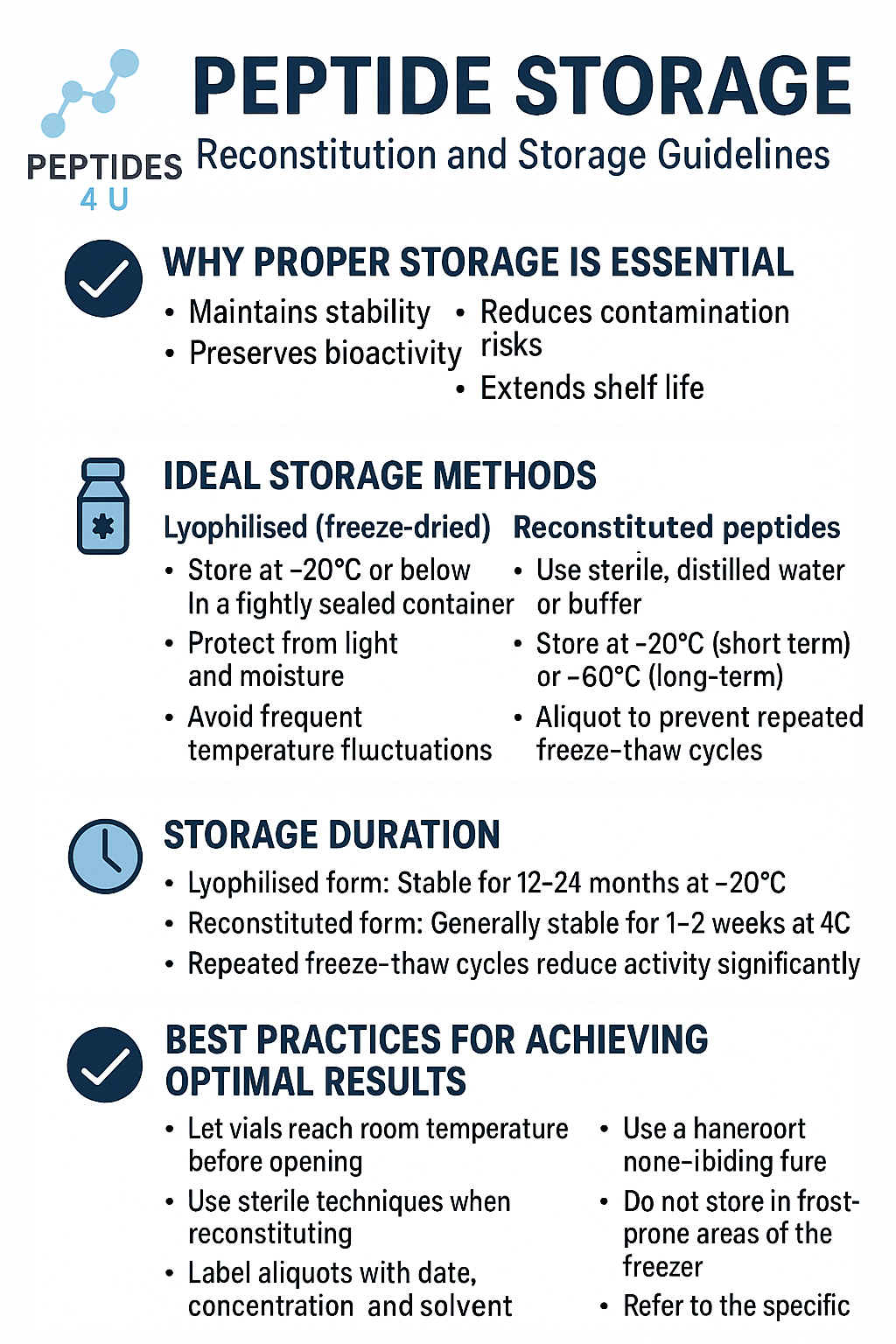
RECONSTITUTING / STORAGE
A Guide
Peptides are delicate biomolecules that can lose their stability and effectiveness if not handled correctly. Proper reconstitution and storage ensure they remain potent and safe for research or therapeutic purposes. Always follow the manufacturer’s instructions first, but the guidelines below serve as a general framework.
⸻
Why Proper Storage Is Essential
• Maintains stability: Improper storage can lead to degradation, oxidation, or hydrolysis.
• Preserves bioactivity: Degraded peptides may no longer produce reliable or reproducible results.
• Reduces contamination risks: Correct storage conditions lower the risk of microbial growth after reconstitution.
• Extends shelf life: Following best practices can help maintain peptide usability over weeks or months.
⸻
Ideal Storage Methods
For Lyophilised (Freeze-Dried) Peptides
• Store at –20 °C or below in a tightly sealed container.
• Protect from light and moisture; keep vials tightly capped.
• Avoid frequent temperature fluctuations (minimize freeze–thaw cycles).
For Reconstituted Peptides
• Use sterile, distilled water or buffer recommended by the supplier.
• Once dissolved, store at –20 °C (short-term) or –80 °C (long-term) in small aliquots.
• Aliquoting prevents repeated freeze–thaw damage.
⸻
Storage Duration
• Lyophilised form: Stable for 12–24 months at –20 °C (sometimes longer if kept dry and sealed).
• Reconstituted form: Generally stable for 1–2 weeks at 4 °C; longer stability (several months) if stored at –20 °C or –80 °C in aliquots.
• Repeated freeze–thaw cycles reduce activity significantly.
⸻
Best Practices for Achieving Optimal Results
• Always let vials reach room temperature before opening to prevent condensation.
• Use sterile techniques when reconstituting to avoid contamination.
• Label aliquots with date, concentration, and solvent for easy tracking.
• Avoid vigorous shaking; instead, gently swirl to dissolve peptides.
⸻
Additional Tips
• If solubility is poor, use a small amount of an organic solvent (like DMSO or acetic acid) before diluting with water or buffer.
• Always prepare aliquots in low-binding tubes to reduce peptide loss.
• Do not store in frost-prone areas of the freezer where thawing can occur.
• Refer to the specific peptide’s datasheet for stability notes (some sequences are more sensitive than others).
Save the table to your own device below for quick access